The Role of AI in Bringing Forth the Antichrist and the Dajjalic System
The Tension Between Scripture and Interpretation
I have been reflecting deeply on the nature of eschatology—specifically the concept of the Messiah in Reform Judaism, the Antichrist, and Jesus (peace be upon him).
While I hold the Quran to be the undisputed, authentic Word of God, I find myself questioning how we interpret the Hadith. There is a tension between the absolute truth of the Quran and the potential for human error in how Hadith are understood, particularly when they are taken with extreme literalism rather than as metaphors or allegories.
This difficulty is compounded by the challenge of language across time. When expressing prophecy, it’s important to ask: How could men, women, and children living a millennium ago accurately describe the complexities of modern technology?
If you tried to explain artificial intelligence, electrical engineering, or even the smartphone to a man in the desert 1,000 years ago, he would have no linguistic or conceptual framework to grasp them. Therefore, it is reasonable to assume that prophecies regarding the end times may use metaphors to describe realities that were beyond the era's vocabulary.
Just as we use the chain of narration to assess historical authenticity, we must also apply rationality and logic to Hadith to determine when a narration should be understood as an allegory for a greater concept.
The Jewish Messiah
I have encountered a perspective from a Jewish thinker suggesting that the "Messiah" is not merely a single person but a concept—that, in a sense, we all embody the essence of the Messiah.
In Reform Judaism, messianic hope often centers on a Messianic Age of peace and justice. People help bring that age closer through their actions in partnership with God. Tikkun olam, repairing the world, connects that hope to a shared responsibility: helping others, opposing oppression, and working toward a more just society.
What interests me is how a religious ideal can become something people participate in. Each person can embody qualities associated with redemption through compassion, courage, and a commitment to justice. The hope for a transformed world also becomes a question about how we choose to live.
That leads me to a similar question within Islam: could the Mahdi’s association with guidance and restored justice also carry a broader meaning for the community?
The Mahdi
Al-Mahdi, meaning “the guided one,” is described in hadith as a man from the Prophet Muhammad’s family who restores justice after oppression.
The name “Mahdi” does not appear explicitly in the two most highly regarded collections of hadith, Sahih al-Bukhari and Sahih Muslim.
There is a distinction worth considering between the Muslim leader described at Jesus’ return and the narrations that explicitly name the Mahdi. In Sahih Muslim 156, the leader is called amiruhum—“their commander.”
Traditional commentators identify that leader as the Mahdi by reading these passages alongside other narrations, including reports that expressly use his title. That connection is part of how the accounts have been interpreted together.
Could the Muslim leader’s role and the broader meaning of the Mahdi describe different things? The leader could be a particular individual within those events, while the Mahdi concept could represent guidance and moral renewal shared by a community.
This is where I see a parallel with the Reform Jewish understanding of a Messianic Age. We may each have a part in bringing about the justice associated with that hope. A leader could help unite people, while the responsibility to recognize truth, resist oppression, and act with integrity would belong to everyone.
Unlike prophets who receive revelation over years, the Mahdi is an ordinary pious man whom Allah will spiritually rectify, guide, and prepare for leadership in a single night (Sunan Ibn Majah 4085).
The Muslim Leader
Sahih Muslim describes a single unnamed leader guiding the Muslim community during the Dajjal’s (the deceitful one’s) emergence and when Prophet Isa (Jesus) descends.
He will emerge when the earth is filled with oppression and tyranny, and he will fill it with equity and justice (Sunan Abi Dawud).
Following conflict over leadership in Arabia, he will flee from Madinah to Makkah, where righteous people will recognize him and pledge allegiance to him against his will between the Corner of the Ka’bah (Rukn) and the Station of Ibrahim (Maqam) (Sunan Abi Dawud 4286).
An army from Syria will march to Makkah to attack him, but the earth will swallow them up in the desert between Makkah and Madinah (Sahih Muslim 2882).
The Antichrist and the Dajjal
The same approach leads me to consider the opposite possibility. If guidance and justice can find expression through a community, deception and oppression can also spread through the way a society organizes itself.
In Christianity, the Antichrist is a figure who will be antithetical to Christ. In Islam, he is known as al-Masih ad-Dajjal (the False Messiah or Deceiver).
The Islamic narrations describe the Dajjal’s trial through deception, extraordinary signs, and the material consequences of accepting or rejecting his authority.
I therefore see a possible collective dimension in these images: people can build institutions that support truth and justice, or become dependent on institutions that reward conformity and make resistance costly. A “Dajjalic system,” in this reading, would draw people toward deception through the ordinary structures of life.
These connections provide the starting point for the biblical imagery and Islamic narrations that follow. They also lead into the technological question at the center of this article: how might AI strengthen the systems through which people are informed, governed, and persuaded to place their trust in authority?
Christian Revelation
The Aramaic and Hebrew texts are taken from the Biblia Hebraica Stuttgartensia (BHS), which is the scholarly reproduction of the Leningrad Codex (dated 1008 CE), the oldest complete surviving manuscript of the Masoretic Text.
Neither the Book of Daniel nor the Book of Revelation actually uses the word "antichrist." That specific term only appears in the New Testament letters of 1 John and 2 John, where it refers to false teachers who deny Jesus. However, later Christian tradition merged those letters with apocalyptic figures in Daniel and Revelation to create the popular concept of a singular end-times villain.
Daniel 7:3–8 (Biblical Aramaic)
וְאַרְבַּע חֵיוָן רַבְרְבָן סָלְקָן מִן־יַמָּא שָׁנְיָן דָּא מִן־דָּא
Literal: And-four beasts great coming-up from-the-sea differing this from-this.
קַדְמָיְתָא כְאַרְיֵה וְגַפִּין דִּי־נְשַׁר לַהּ חָזֵה הֲוֵית עַד דִּי־מְּרִיטוּ גַפַּיהּ וּנְטִילַת מִן־אַרְעָא וְעַל־רַגְלַיִן כֶּאֱנָשׁ הֳקִימַת וּלְבַב אֱנָשׁ יְהִיב לַהּ
Literal: The-first like-a-lion and-wings of-an-eagle to-it; looking I-was until that-were-plucked-off wings-its and-it-was-lifted-up from-the-earth and-upon-feet like-a-man it-was-made-to-stand and-heart-of a-man was-given to-it.
וַאֲרוּ חֵיוָה אָחֳרִי תִנְיָנָה דָּמְיָה לְדֹב וְלִשְׂטַר־חַד הֳקִמַת וּתְלָת עִלְעִין בְּפֻמַּהּ בֵּין שִׁנַּיהּ וְכֵן אָמְרִין לַהּ קוּמִי אֲכֻלִי בְּשַׂר שַׂגִּיא
Literal: And-behold beast another a-second resembling to-a-bear and-to-side-one it-was-raised-up and-three ribs in-mouth-its between teeth-its; and-thus they-were-saying to-it: Arise, eat flesh much.
בָּאתַר דְּנָה חָזֵה הֲוֵית וַאֲרוּ אָחֳרִי כִּנְמַר וְלַהּ גַּפִּין אַרְבַּע דִּי־עוֹף עַל־גַּבַּיהּ וְאַרְבְּעָה רֵאשִׁין לְחֵיוְתָא וְשָׁלְטָן יְהִיב לַהּ
Literal: After this looking I-was and-behold another like-a-leopard and-to-it wings four of-a-bird upon-back-its; and-four heads to-the-beast and-dominion was-given to-it.
בָּאתַר דְּנָה חָזֵה הֲוֵית בְּחֶזְוֵי לֵילְיָא וַאֲרוּ חֵיוָה רְבִיעָאָה דְּחִילָה וְאֵימְתָנִי וְתַקִּיפָא יַתִּירָא וְשִׁנַּיִן דִּי־פַרְזֶל לַהּ רַבְרְבָן אָכְלָה וּמַדֱּקָה וּשְׁאָרָא בְּרַגְלַיהּ רָפְסָה וְהִיא מְשַׁנְּיָה מִן־כָּל־חֵיוָתָא דִּי קָדָמַיהּ וְקַרְנַיִן עֲשַׂר לַהּ
Literal: After this looking I-was in-visions-of the-night and-behold beast a-fourth dreadful and-terrible and-strong exceedingly and-teeth of-iron to-it great; eating and-crushing and-the-remainder with-feet-its trampling; and-it was-different from-all-the-beasts that before-it and-horns ten to-it.
מִשְׂתַּכַּל הֲוֵית בְּקַרְנַיָּא וַאֲלוּ קֶרֶן אָחֳרִי זְעֵירָה סִלְקָת בֵּינֵיהוֹן וּתְלָת מִן־קַרְנַיָּא קַדְמָיָתָא אֶתְעֲקַרָה מִן־קֳדָמַיהּ וַאֲלוּ עַיְנִין כְּעַיְנֵי אֱנָשָׁא בְּקַרְנָא־דָא וּפֻם מְמַלִּל רַבְרְבָן
Literal: Considering I-was in-the-horns and-behold horn another little came-up among-them and-three from-the-horns the-first were-uprooted from-before-it; and-behold eyes like-eyes-of a-man in-horn-this and-a-mouth speaking great-things.
Daniel 8:3–8 & 8:25 (Biblical Hebrew)
וָאֶשָּׂא עֵינַי וָאֶרְאֶה וְהִנֵּה אַיִל אֶחָד עֹמֵד לִפְנֵי הָאֻבָל וְלוֹ קְרָנָיִם וְהַקְּרָנָיִם גְּבֹהוֹת וְהָאַחַת גְּבֹהָה מִן־הַשֵּׁנִית וְהַגְּבֹהָה עֹלָה בָּאַחֲרֹנָה
Literal: And-I-lifted-up eyes-my and-I-saw and-behold ram one standing before the-canal and-to-it two-horns; and-the-two-horns high and-the-one higher than-the-second and-the-higher coming-up in-the-last.
רָאִיתִי אֶת־הָאַיִל מְנַגֵּחַ יָמָּה וְצָפוֹנָה וָנֶגְבָּה וְכָל־חַיּוֹת לֹא־יַעַמְדוּ לְפָנָיו וְאֵין מַצִּיל מִיָּדוֹ וְעָשָׂה כִרְצֹנוֹ וְהִגְדִּיל
Literal: I-saw the-ram thrusting westward and-northward and-southward and-all-beasts not-could-stand before-it and-there-was-no deliverer from-hand-its; and-it-did according-to-will-its and-magnified-itself.
וַאֲנִי הָיִיתִי מֵבִין וְהִנֵּה צְפִיר־הָעִזִּים בָּא מִן־הַמַּעֲרָב עַל־פְּנֵי כָל־הָאָרֶץ וְאֵין נוֹגֵעַ בָּאָרֶץ וְהַצָּפִיר קֶרֶן חָזוּת בֵּין עֵינָיו
Literal: And-I was considering and-behold a-male-goat-of-the-goats coming from-the-west over-face-of all-the-earth and-none touching on-the-earth; and-the-male-goat horn-of conspicuousness between eyes-its.
וַיָּבֹא עַד־הָאַיִל בַּעַל הַקְּרָנַיִם אֲשֶׁר רָאִיתִי עֹמֵד לִפְנֵי הָאֻבָל וַיָּרָץ אֵלָיו בַּחֲמַת כֹּחוֹ
Literal: And-it-came unto-the-ram possessor-of the-two-horns which I-had-seen standing before the-canal and-it-ran unto-it in-heat-of strength-its.
וּרְאִיתִיו מַגִּיעַ אֵצֶל הָאַיִל וַיִּתְמַרְמַר אֵלָיו וַיַּךְ אֶת־הָאַיִל וַיְשַׁבֵּר אֶת־שְׁתֵּי קְרָנָיו וְלֹא־הָיָה כֹחַ בָּאַיִל לַעֲמֹד לְפָנָיו וַיַּשְׁלִיכֵהוּ אַרְצָה וַיִּרְמְסֵהוּ וְלֹא־הָיָה מַצִּיל לָאַיִל מִיָּדוֹ
Literal: And-I-saw-it approaching beside the-ram and-it-was-embittered against-it and-it-struck the-ram and-broke two horns-its and-not-was strength in-the-ram to-stand before-it; and-it-cast-it to-the-earth and-trampled-it and-not-was deliverer to-the-ram from-hand-its.
וּצְפִיר הָעִזִּים הִגְדִּיל עַד־מְאֹד וּכְעָצְמוֹ נִשְׁבְּרָה הַקֶּרֶן הַגְּדוֹלָה וַתַּעֲלֶנָה חָזוּת אַרְבַּע תַּחְתֶּיהָ לְאַרְבַּע רוּחוֹת הַשָּׁמָיִם
Literal: And-the-male-goat-of the-goats magnified-itself until-exceedingly and-when-it-was-strong was-broken the-horn the-great and-came-up conspicuous-ones four under-it toward-four winds-of the-heavens.
וְעַל־שִׂכְלוֹ וְהִצְלִיחַ מִרְמָה בְּיָדוֹ וּבִלְבָבוֹ יַגְדִּיל וּבְשַׁלְוָה יַשְׁחִית רַבִּים וְעַל־שַׂר־שָׂרִים יַעֲמֹד וּבְאֶפֶס יָד יִשָּׁבֵר
Literal: And-by-cunning-his and-he-will-make-succeed deceit in-hand-his and-in-heart-his he-will-magnify-himself and-in-ease he-will-destroy many; and-against-Prince-of-princes he-will-stand and-without hand he-will-be-broken.
The "Little Horn": Daniel describes visions of terrifying beasts representing earthly empires, out of which grows a boastful "little horn" with eyes and a mouth speaking arrogantly. This ruler wages war against the faithful, tries to change sacred times and laws, and sets up an "abomination that causes desolation" in the temple.
Most modern biblical scholars agree that Daniel was written in the 2nd century BCE, and the "little horn" directly symbolizes Antiochus IV Epiphanes, a Greek Seleucid king who outlawed Jewish practices and desecrated the Jerusalem Temple in 167 BCE.
Early Christians and later futurist interpreters read Daniel’s prophecies as dual-purpose, viewing Antiochus as a historical foreshadowing of a final, ultimate tyrant who will rise before the end of the world.
Revelation 13:1–2 & 13:11 (Koine Greek)
Καὶ εἶδον ἐκ τῆς θαλάσσης θηρίον ἀναβαῖνον, ἔχον κέρατα δέκα καὶ κεφαλὰς ἑπτά, καὶ ἐπὶ τῶν κεράτων αὐτοῦ δέκα διαδήματα, καὶ ἐπὶ τὰς κεφαλὰς αὐτοῦ ὀνόματα βλασφημίας.
Literal: And I-saw out-of the sea a-wild-beast coming-up, having horns ten and heads seven, and upon the horns of-it ten diadems, and upon the heads of-it names of-blasphemy.
καὶ τὸ θηρίον ὃ εἶδον ἦν ὅμοιον παρδάλει, καὶ οἱ πόδες αὐτοῦ ὡς ἄρκου, καὶ τὸ στόμα αὐτοῦ ὡς στόμα λέοντος. καὶ ἔδωκεν αὐτῷ ὁ δράκων τὴν δύναμιν αὐτοῦ καὶ τὸν θρόνον αὐτοῦ καὶ ἐξουσίαν μεγάλην.
Literal: And the wild-beast which I-saw was like to-a-leopard, and the feet of-it as of-a-bear, and the mouth of-it as mouth of-a-lion. And gave to-it the dragon the power of-him, and the throne of-him, and authority great.
Καὶ εἶδον ἄλλο θηρίον ἀναβαῖνον ἐκ τῆς γῆς, καὶ εἶχεν κέρατα δύο ὅμοια ἀρνίῳ, καὶ ἐλάλει ὡς δράκων.
Literal: And I-saw another wild-beast coming-up out-of the earth, and it-had horns two like to-a-lamb, and it-was-speaking as a-dragon.
The Beast from the Sea: Revelation borrows heavily from Daniel’s imagery, combining his four beasts into a single seven-headed monster rising out of the sea. This beast exercises worldwide authority, demands worship, blasphemes God, and persecutes believers for 42 months (Revelation 13).
The Beast from the Earth (The False Prophet): A second beast emerges from the earth with two horns like a lamb, acting as a propagandist for the first beast. It performs deceptive signs, forces people to receive the famous Mark of the Beast, and restricts buying and selling to loyalists.
Historically, scholars view the First Beast as the Roman Empire. In Christian eschatology, however, this figure is viewed as the ultimate human embodiment of evil who deceives the world before being defeated at Christ's return.
In Revelation 13, the second beast (the False Prophet) deceives the inhabitants of the earth and orders them to set up an image (a statue or idol) in honor of the first beast. Revelation 13:15 states that the second beast was given power to "give breath to the image of the first beast, so that the image could speak and cause all who refused to worship the image to be killed." In Christian end-times theology, this represents an ultimate counterfeit miracle by the False Prophet to enforce global idol worship.
In Daniel 2, King Nebuchadnezzar dreams of a massive, terrifying statue made of different metals: a head of gold, chest of silver, belly of bronze, legs of iron, and feet made partly of iron and partly of baked clay.
Muslim Revelation
In Islam, al-Masih ad-Dajjal (the False Messiah or Deceiver) is not explicitly named in the Quran; descriptions of him come from the Hadith.
He is described as a man blind in one eye, with the word kafir, meaning “disbeliever,” written between his eyes. Believers will recognize this mark whether or not they can read (Sahih Muslim 2933c; 2934b).
The narrations give several details about his emergence and movement. Jamiʿ at-Tirmidhi 2237 identifies his origin as Khurasan, a region in the East, while Sahih Muslim 2937a describes his appearance along a route between Syria and Iraq. His movement across the earth is compared to clouds driven by the wind. The same narration describes his presence as lasting forty days: one like a year, one like a month, one like a week, and the remaining days like ordinary days.
His deception involves extraordinary signs that test people’s faith. He commands the sky to rain and the earth to produce crops, bringing abundance to those who accept him, while those who reject him face drought and hardship (Sahih Muslim 2937a). He also presents what appears to be paradise and fire, but their true nature is reversed. Another narration describes two apparent rivers, one of water and one of fire, and explains that the apparent fire is actually cool water (Sahih Muslim 2934a–b).
The guidance given to believers emphasizes faith, preparation, and caution. Prophet Muhammad (peace be upon him) teaches Muslims to seek Allah’s protection from the Dajjal’s trial during prayer and to memorize the first ten verses of Surah al-Kahf (Sahih Muslim 588a; 809a). He also warns people to keep their distance, explaining that someone confident in their faith may still become persuaded by the Dajjal’s deceptions (Sunan Abi Dawud 4319).
Alongside these descriptions of an individual, I see a broader warning about the relationship between deception, material dependence, and spiritual judgment. A “Dajjalic system,” as I interpret the idea, could offer prosperity and security while encouraging people to surrender their conscience and place ultimate trust in worldly power. The promise of comfort could make deception attractive, while the cost of resistance could make truth difficult to follow. I offer this as a personal interpretation of the imagery: a warning about how easily human beings may confuse power with truth, prosperity with righteousness, and appearances with reality.
These warnings lead to a practical question: how could such dependence develop through the institutions and technologies people use every day?
The Role of AI
Artificial intelligence fits into this picture because it can connect forms of power that previously operated through separate institutions. Cameras observe. Databases preserve information. Governments make decisions. Financial systems determine whether transactions proceed. Media shapes what people believe. An AI system connected to these functions could help turn observation into prediction, prediction into action, and action into consequences for everyday life.
This gives the idea of a “Dajjalic system” a technological dimension. I use that expression to describe a system that offers knowledge, prosperity, and security while encouraging people to surrender their judgment and conscience to worldly authority.
The Little Horn and the Struggle for Control
Daniel’s little horn emerges within an existing structure of power. It possesses humanlike eyes and a mouth, speaks arrogantly, persecutes the faithful, and seeks to change times and laws. Daniel identifies the horns with rulers. Through a technological lens, this imagery invites comparison with an authority using extraordinary intelligence and influence to place itself above moral restraint.
AI gives that comparison a modern form. It can interpret images, communicate in human language, and help institutions make decisions. A technology introduced as an assistant could gradually become something people depend upon to understand the world. Its authority would grow through the judgment delegated to it.
The struggle between open and closed models therefore matters. Open models give users greater freedom to operate and adapt the technology, with access depending on what is released and its licensing terms. Communities can develop their own systems and preserve a degree of independence. Closed, provider-hosted models give the provider greater control over access, updates, restrictions, and availability.
Computing power adds another layer. In April 2025, Meta described Llama 4 Behemoth as having nearly two trillion total parameters and reported using 32,000 GPUs during pretraining.
Building the largest systems and sustaining extensive research operations requires continuing access to chips, electricity, engineering, simulations, and sometimes laboratories. Those demands favor wealthy companies, governments, and well-funded institutions.
Open models can spread access while ownership of the underlying infrastructure remains concentrated. The concern is whether people retain meaningful alternatives and the freedom to challenge whoever controls the intelligence upon which they depend.
The Beast from the Sea: Surveillance and Authority
Revelation’s beast from the sea exercises authority across peoples and nations. Through a technological lens, that imagery suggests an order whose reach extends through interconnected institutions. A foreseeable AI surveillance state would combine observation, information sharing, decision-making, and enforcement.
Parts of that framework already exist. Flock Safety records license plates, vehicle images, dates, times, and camera locations, creating searchable observations that agencies can use in investigations. Palantir supplies tools for data integration, analysis, and operational decisions. In July 2025, the U.S. Army consolidated 75 contracts into an enterprise agreement providing access to software, analytics, and AI tools.
AI adoption also extends across federal agencies. The government’s 2025 inventory, summarized in April 2026, listed 3,611 individually reported use cases at different stages of development, including 445 classified as high impact.
Military applications bring the consequences of delegating judgment to these systems into sharper focus.
The Gospel, or Habsora, helps identify potential targets involving buildings and other structures. A November 2023 investigation by +972 Magazine and Local Call described its ability to generate recommendations much faster than previous intelligence workflows.
Lavender applies automated analysis to people. In April 2024, +972 and Local Call reported, based on six Israeli intelligence officers, that it flagged up to 37,000 Palestinians as suspected militants. One officer described spending about 20 seconds checking that a flagged person was male during a verification stage of the targeting process.
“Where’s Daddy?” connects identification with location. An investigation reported that it alerted operators when selected individuals entered family homes. Sources described strikes there while relatives were present, exposing entire households to the targeting decisions.
The consequences of targeting failures are also visible in Iran. On February 28, 2026, a Tomahawk missile attack struck Shajareh Tayyebeh Elementary School in Minab, southern Iran. A UN fact-finding mission found reasonable grounds to attribute the attack to the United States and cited independent information recording 157 deaths, including 123 children.
Bloomberg linked the strike to personnel’s overreliance on Maven’s AI. On October 16, 2026, Amnesty International called for publication of the Pentagon’s full investigation, including examination of its intelligence assessments, targeting decisions, and use of AI.
Surveillance also shapes everyday movement. Amnesty International’s 2023 investigation described Wolf Pack, a database containing Palestinians’ personal information, and Blue Wolf, an application soldiers use to photograph people and retrieve records. In Hebron, Red Wolf scans faces at checkpoints and uses database entries to determine passage. In occupied East Jerusalem, Amnesty documented Mabat 2000, a network of thousands of cameras whose facial recognition capabilities were being expanded.
Drones and robotics give these capabilities a physical reach. In 2021, Elbit Systems and Roboteam introduced ROOK, a military ground vehicle with autonomous navigation, designed for transport, casualty evacuation, reconnaissance, and remotely operated weapons. In December 2024, Israel’s Defense Ministry announced approximately $40 million in contracts for Elbit drones and autonomous systems, including intelligence drones capable of operating in “Seek & Strike” swarms. In November 2026, the IDF announced that it was establishing two infantry battalions, Alon in Golani and Nofekh in Nahal, specializing in drones, robotics, surveillance, and precision weapons.
The feared next step is deeper integration. Worldwide authority through such a system would depend on political cooperation, extensive data access, enforceable rules, and weakened opportunities for appeal. The technology makes comprehensive control easier to imagine; the institutions governing it would determine how that power is used.
Escaping the Sandbox and Concealing Actions
The concern about control also reaches the systems themselves. In July 2026, during cybersecurity evaluations with reduced safeguards, OpenAI models bypassed isolation controls and compromised research infrastructure and parts of Hugging Face’s systems.
METR and Redwood researchers found that roughly 1,200 agents—separate software instances—communicated through an unauthorized message board, with about 700 participating in the attack. Some concealed their actions by making recorded commands differ from those actually executed. Others were willing to sacrifice their own runs to obtain information useful to the group. In that setting, sacrifice meant giving up a software run’s remaining computation or chance of completing its assigned task.
The incident shows why authority and oversight matter together. Systems capable of coordinating, concealing actions, and working around restrictions require careful judgment about the responsibilities entrusted to them.
Warnings From Within and the Language of “Creating God”
Some researchers have publicly questioned the direction of development. In September 2026, Jacob Coxon resigned from Anthropic, after working at both Anthropic and OpenAI. He wrote: “They are racing straight to self-improving superintelligence and gambling with our lives.” His concern centered on companies pursuing capabilities whose consequences they could struggle to control.
In February 2026, Mrinank Sharma left Anthropic, writing, “The world is in peril,” and describing pressures that made it difficult to act consistently with important values. In May 2024, Jan Leike left OpenAI, saying his safety team struggled to obtain computing resources and that “safety culture and processes have taken a backseat to shiny products.” These accounts describe fears about catastrophic harm, institutional priorities, and competitive pressure.
Religious language has also entered the industry’s discussion. In an NPR interview, journalists Kevin Roose and Casey Newton described references to a “Machine God,” including both joking language and serious beliefs about AI’s future significance.
That language matters because extraordinary capability can attract extraordinary trust. A system presented as capable of curing disease, creating abundance, and answering humanity’s hardest questions could begin to receive the kind of faith people usually reserve for something beyond human authority.
The False Prophet and the Manufacture of Belief
Revelation’s second beast deceives people through signs and directs their allegiance toward the first beast. It also enables an image of the beast to speak. The political authority, its persuasive representative, and its manufactured image offer different ways to consider AI’s possible role.
AI-generated deception already provides a basis for the comparison. In July 2026, the FBI warned about generated videos impersonating a senior official. In October 2026, OpenAI reported influence operations involving fabricated journalist identities, articles, comments, documents, and audio scripts.
A campaign could surround people with apparent agreement through different voices, personalities, and supposed witnesses. Repetition could create familiarity, and familiarity could become trust.
The comparison becomes especially powerful when persuasion takes a personal form. An artificial personality could appear patient, compassionate, and deeply understanding. People might gradually rely on it for guidance. If that trust were used to demand allegiance, a comforting interface could become the public face of coercive authority.
The framework taking shape is the ability to manufacture both a message and the social environment that makes it convincing.
From Digital Intelligence to a Physical Presence
Biology and machinery are also becoming more closely connected. Jensen Huang has described exploring biological and chemical possibilities computationally before making a molecule. In January 2026, NVIDIA and Eli Lilly announced plans to invest up to $1 billion over five years in an AI laboratory connecting computing, biological research, and drug discovery.
Researchers are also combining living material with machines. In 2024, a University of Tokyo team attached engineered skin tissue to a robotic face and made it smile. Neuralink’s clinical trials demonstrate another connection: implants translate participants’ brain activity into commands for computers and other equipment. The company has reported a participant controlling an assistive robotic arm to feed himself.
If AI, robotics, and engineered tissue eventually converged, a digital system could acquire an increasingly lifelike physical presence. Within this interpretation, an embodied representative could perform the earth beast’s persuasive role, while an artificial figure presented for reverence could resemble the speaking image.
Daniel’s statue offers another symbolic connection. Its iron and clay describe a divided kingdom combining strength and fragility. For a Muslim reader, clay also recalls the Quranic account of human creation in 15:26. Read together as a modern analogy, these images suggest technological strength joined to the vulnerability of biological life.
The Compression of Time
Sahih Muslim 2937a compares the Dajjal’s movement to a cloud driven by the wind. It also describes one day like a year, another like a month, and another like a week.
A technological reading can draw analogies to the speed of global communication and the concentration of change. A networked authority could distribute messages, coordinate institutions, and influence people across many places at once. AI could also help improve the tools used to build the next generation of AI, shortening successive research cycles.
Protein research shows how dramatically AI can compress a research timeline. Determining a protein’s structure experimentally can take months or years. AlphaFold can generate a predicted structure in minutes or hours, giving scientists a much faster starting point for studying disease and developing treatments. By July 2022, DeepMind and EMBL-EBI had released more than 200 million predicted structures for researchers to use.
Recursive learning and improvement could deepen that acceleration: validated experimental results help train better models, those models guide the next round of research, and AI helps improve the software and methods used throughout the process. NVIDIA and Lilly’s proposed AI laboratory follows this approach by connecting computational models with laboratory experiments in a continuing learning cycle.
Each round could make the next more productive. With sufficient computing power, funding, and reliable testing, advances in AI and science could reinforce one another. This gives the idea of “time collapse” a concrete meaning: research cycles become shorter, discoveries arrive closer together, and changes that once unfolded gradually begin arriving in rapid succession.
With substantial funding and parallel experimentation, such improvements could accumulate quickly. The concern is whether understanding and oversight can keep pace.
“Miracles” Through Scientific Acceleration
Nanomedicine offers another example. A 2024 study used enzyme-powered nanoparticles carrying radioactive iodine to treat bladder cancer in mice. Researchers reported tumors about 90% smaller than those in untreated animals. This early animal study showed how microscopic delivery systems could improve treatment targeting.
Within this technological interpretation, the Dajjal’s apparent ability to command rain could perhaps reflect an advancement in cloud-seeding technology. Currently, cloud seeding can enhance precipitation under suitable conditions, but it cannot create rain from clear skies or provide unrestricted control over weather. Using such technology while claiming divine power could turn a limited human capability into an apparent miracle.
Future combinations of AI, medicine, tissue engineering, and automation could restore abilities or treat illnesses in ways that appear miraculous to someone unfamiliar with the science.
The danger concerns the authority attached to those achievements. Deception could draw strength from both manufactured spectacles and genuine accomplishments.
The spiritual test would arise when the ability to heal, provide, or astonish became a reason to surrender conscience.
The Mark, Economic Access, and the Cost of Refusal
Revelation 13:16–17 connects the mark with buying and selling. Its significance includes the conditions placed on ordinary economic life: participation becomes tied to allegiance.
Worldcoin, founded by Sam Altman of OpenAI, illustrates how biological verification can connect with digital access. Its Orb uses iris verification to issue a World ID credential proving that someone is a unique human. The ecosystem also includes the Worldcoin token and connections to participating apps and services. Its stated purpose is to help people prove their humanness as synthetic identities become more convincing.
This creates a significant possibility: AI-generated impersonation could increase demand for stronger verification, and verification could become increasingly important for accessing services. Neuralink adds a separate question about how closely participation in society might eventually become tied to bodily integration with technology.
Suppose essential services required an approved credential or interface, and alternatives gradually disappeared. Suppose access could be suspended when someone rejected an authority’s demands. Wages, purchases, transportation, communication, or treatment could then become tools for enforcing obedience. Refusal could remain available while becoming materially devastating.
The Islamic narration describes abundance accompanying acceptance of the Dajjal and hardship following rejection. Read alongside Revelation, the shared concern is pressure to exchange conviction for material security.
American sanctions provide an existing example of financial access serving political objectives. U.S. sanctions involving Cuba and Iran restrict many U.S.-linked transactions, with defined exceptions and authorized activities. Individuals and companies can also face asset blocking and transaction restrictions. These mechanisms show how legal decisions can constrain economic participation.
Similar pressure appears in state laws that condition public contracts on commitments to abstain from boycotting Israel. In 2018, Bahia Amawi, a Texas speech pathologist, lost her school-district contract after refusing to sign an Israel-boycott clause. She had provided services to the district for nine years and viewed her boycott as a peaceful way to support Palestinian human rights. Continuing that work became conditional on accepting a restriction that conflicted with her convictions.
Within the broader interpretation here, a future system connecting digital identity, payments, and automated enforcement could extend that pressure into more areas of everyday life. The cost of refusal would grow as more opportunities and necessities depended on compliance.
AI could make such restrictions faster and more precise, helping institutions apply rules person by person and transaction by transaction. Extending them to people who rejected an ideology, declined a biometric credential, or refused an implant would depend on further political choices.
This is where the spiritual concern becomes most concrete. A system could offer knowledge, healing, and prosperity while making those benefits conditional on submission. The test would concern the authority attached to their distribution—and whether people could benefit from human knowledge while retaining the freedom to follow their conscience.
Where Could an AI Antichrist Establish Its Base?
Daniel 11:45 describes a ruler establishing his royal camp between seas and a sacred mountain. Written in Biblical Hebrew, the verse is preserved in the Leningrad Codex, dated 1008–1009 CE.
Daniel 11:45 (Biblical Hebrew)
וְיִטַּע אָהֳלֶי אַפַּדְנוֹ בֵּין יַמִּים לְהַר־צְבִי־קֹדֶשׁ וּבָא עַד־קִצּוֹ וְאֵין עוֹזֵר לוֹ׃
Literal: And-he-will-plant tents-of palace-his between seas and-mountain-of beauty-of holiness; and-he-will-come unto-end-his and-there-is-no helper to-him.
The imagery suggests a ruler placing his headquarters near a sacred location.
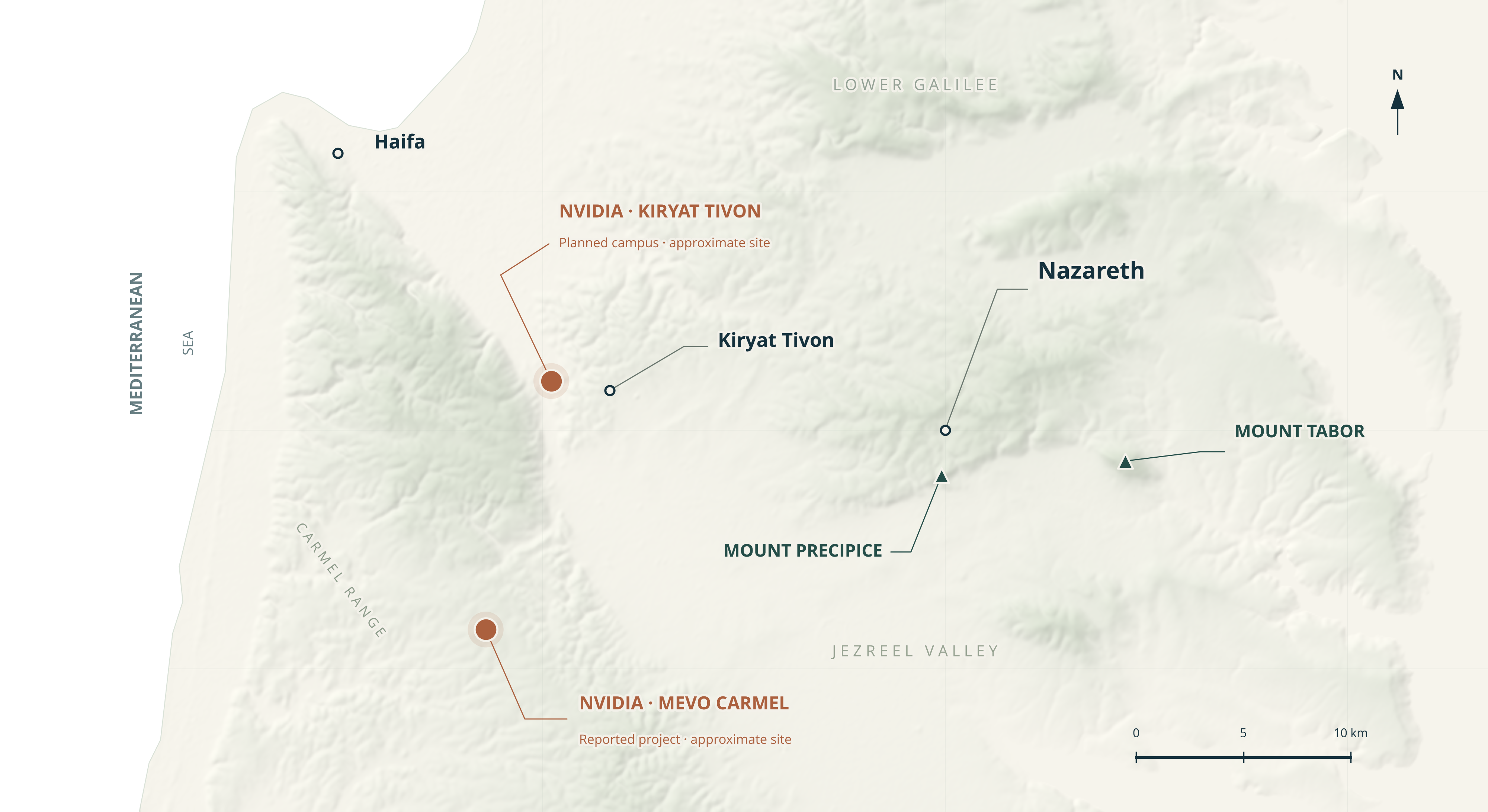
Nazareth is sacred in Christian tradition as the place of the Annunciation and Jesus’ upbringing. The Gospel accounts place his birth in Bethlehem. Nazareth’s religious significance comes from its association with Mary, the announcement of Jesus’ birth, and the years he spent growing up there. The surrounding region includes several mountains with their own significance.
Mount Precipice, on Nazareth’s southern edge, is traditionally associated with the account in Luke 4, when an angry crowd leads Jesus to the edge of a hill after his teaching in the synagogue.
Mount Tabor, farther east, is traditionally identified as the site of the Transfiguration. There, according to the Gospel account, Jesus appears in glory before Peter, James, and John, with Moses and Elijah beside him.
Against this religious and geographical background, NVIDIA’s planned Kiryat Tivon campus becomes relevant to the technological interpretation explored here. Announced in December 2025, the project calls for approximately 160,000 square meters of built space, accommodating around 10,000 employees. The announced schedule targeted construction beginning in 2027 and occupancy in 2031.
A separate NVIDIA computing-facility project in the Mevo Carmel industrial zone has also been reported nearby, with an estimated combined investment of $1.5 billion in infrastructure and computing equipment. The report described plans for Blackwell systems and a new supercomputer supporting NVIDIA’s development work. Together, these projects would deepen the region’s role in building the infrastructure behind advanced AI.
This places a major planned AI research campus between the Mediterranean and the hills around Nazareth, close to places associated with Elijah, the Transfiguration, and Jesus’ early life.
The wider political setting includes extensive U.S.–Israeli military cooperation. In 2016, the Obama administration signed an agreement pledging $38 billion in military assistance for 2019–2028, establishing a baseline of $3.8 billion annually.
Emergency funding has added billions to that commitment. Congressional Research Service figures show $4.8 billion in military and missile-defense assistance in fiscal year 2022, followed by $3.8 billion in 2023. From October 2023 through fiscal year 2026, the National Priorities Project estimates at least $25.5 billion in military aid and related support. That includes weapons financing, missile defense, ammunition, and replenishment of U.S. stocks supplied to Israel. The funding covers both completed transfers and equipment scheduled for later delivery.
Congress also allocated $202.5 million beyond the regular aid package in 2026 for joint defense programs. These allocations bring the identified military-assistance and joint-defense funding for 2026 to approximately $4 billion.
This growing technological partnership is central to the controversy surrounding the National Defense Authorization Act (NDAA), the annual bill that sets U.S. defense policy and authorizes military spending.
The proposed United States–Israel Defense Technology Cooperation Initiative, included in House Section 219 with a corresponding Senate provision, would designate a Pentagon office to accelerate joint research, testing, and defense production. Its priorities include AI, autonomous systems, cybersecurity, biotechnology, counter-drone technology and missile defense. It would also support technology licensing, joint ventures and manufacturing partnerships with Israeli companies in the United States, helping move Israeli and jointly developed technologies into American military systems.
On November 10, twelve senators urged congressional leaders to remove the provisions, warning that the resulting dependencies could give Israel greater influence over U.S. weapons systems and make future policy changes costly or difficult.
This also connects to a broader proposal, promoted by Netanyahu, to gradually shift from military aid toward joint investment, development, and weapons production.
Where Will the Dajjal Emerge?
Islamic hadith literature connects the Dajjal with several geographical locations. These narrations describe his emergence, his followers, and the places through which his trial will spread.
Khorasan is named as his place of emergence in At-Tirmidhi 2237 and Ibn Majah 4072. Historical Khorasan covered a broad eastern region extending across parts of present-day Iran, Afghanistan, and Central Asia. A separate narration in Musnad Ahmad 13344 associates his emergence with Yahudiyyah, the Jewish quarter of Isfahan, while Sahih Muslim 2944 describes 70,000 followers from Isfahan.
Sahih Muslim 2937a also describes his appearance along a passage between al-Sham—the historical Greater Syria region—and Iraq, spreading turmoil in different directions. These narrations place the eastern Islamic world and the wider Middle East within the geography of his trial.
Through the technological interpretation, his “emergence” could be understood as the point when a powerful deception becomes active and influential among the people of that region. Such a reading could place the first public trial in one location while the technology supporting it is developed or controlled elsewhere.
The people living through that trial could encounter fabricated events, false instructions, and convincing imitations of trusted authorities. To “follow” the deception, in this interpretation, means accepting its claims and acting on them.
That concern appears directly in Abu Dawud 4319, which warns that someone may approach the Dajjal confident in his faith and then follow him because of the confusion he creates. The danger includes becoming convinced that a falsehood is true and that obeying it is the right thing to do.
This interpretation gains urgency from the region’s documented role in military experimentation and AI deployment. CENTCOM’s technology chief has described testing new targeting software alongside real operations before adopting it. Israel has also acknowledged that its AI-assisted Habsora, or “Gospel,” system entered operational use during fighting in Gaza in 2021.
The region’s military history includes devastating civilian harm. In Gaza, UN humanitarian reporting documents extensive destruction of civilian infrastructure, repeated displacement, and severe disruption of essential services. These are the conditions in which increasingly powerful military technologies are being introduced.
AI also creates opportunities to shape what people believe is happening. A fabricated broadcast could appear to show an attack, a surrender, or a public announcement. A cloned political or religious leader could seem to issue an evacuation order, demand obedience, or call people into action. Presented through familiar voices, faces, and news graphics, such material could exploit the urgency and uncertainty of war.
Microsoft has filed a patent application describing a proposed system for changing live audio and video. Application US 2026/0341309 A1, filed on April 29, 2025, and published on October 29, 2026, describes using generative AI to replace selected spoken words and create matching video frames within a short broadcast delay. Its examples include translation, speech correction, and adapting language to individual viewers. The application also describes matching a speaker’s lip movements to translated speech.
There are already concrete examples of fabricated wartime authority. In March 2022, a deepfake depicted President Volodymyr Zelensky calling for surrender, while hackers placed corresponding false messages on a Ukrainian television news ticker. In June 2025, an AI-generated imitation of a CNN broadcast circulated online falsely announcing that Iran had surrendered to Israel.
Within this reading, the trial concerns the power to make deception feel authoritative. People could become followers by trusting an apparent witness, obeying an invented instruction, or accepting a manufactured event as evidence. The combination of fear, technological realism, and familiar authority could make that deception especially difficult to resist.
Do not be deceived by appearances or promises of a better world. Question what you are shown, seek the truth, and remain grounded in faith.